
Slovenian Coast Real Estate Market 2026: Why Geography Matters More Than the Economy
ALTUM CAPITAL Market Insight
Independent research based on official statistics, market analysis and practical market experience.
Watch the 30-Second Summary
Introduction
The Slovenian coast accounts for only a small share of the country’s territory, yet it consistently ranks among the most expensive residential markets. While property cycles elsewhere are often driven by interest rates or broader economic conditions, the coastal market follows a different logic. Its defining characteristic is structural scarcity.
Unlike many European coastal regions, Slovenia has only around 47 kilometres of coastline. Most developable land has already been built up or is protected by planning regulations, while demand continues to come from domestic buyers, international purchasers and investors seeking stable long-term assets.
As a result, price movements on the coast are shaped less by short-term market sentiment than by a permanent imbalance between supply and demand. Understanding this imbalance is essential for anyone considering buying, investing or analysing real estate in Slovenia.
Slovenia Real Estate Market 2025: Prices, Trends and Structural Shift
Key Takeaways
- The Slovenian coast remains the country’s second most expensive residential market after Ljubljana.
- Limited land availability is the primary factor supporting long-term property values.
- Demand continues to outpace new supply despite changing economic conditions.
- Each coastal municipality represents a distinct market with different buyer profiles and investment characteristics.
Prefer listening instead of reading?
The Geography of Scarcity
Geography is the single most important factor shaping the Slovenian coastal property market. Unlike demand, which fluctuates over time, the amount of land available for development is effectively fixed.
Slovenia has approximately 47 kilometres of Adriatic coastline. Within this narrow coastal strip, residential development competes with tourism, transport infrastructure, environmental protection and historic urban centres. As a result, opportunities for large-scale residential construction remain limited.
Planning regulations further reinforce this constraint. Protected natural areas, heritage preservation and strict zoning policies reduce the number of sites suitable for new housing projects. Even where development is possible, obtaining permits often requires lengthy planning procedures.
This structural limitation explains why periods of weaker demand rarely lead to significant price corrections. When market activity slows, transaction volumes may decline, but owners are generally under little pressure to sell at substantial discounts because replacement supply remains scarce.
For long-term investors, this creates a market that behaves differently from regions where new construction can rapidly respond to rising demand. On the Slovenian coast, supply expands slowly, while demand tends to recover more quickly after economic downturns.
Properties for Sale on the Slovenian Coast
Market Performance in 2025–2026
According to the Surveying and Mapping Authority of the Republic of Slovenia (GURS), the Slovenian coastal region remained the country’s second most expensive residential market in 2025, behind only Ljubljana. The median price of existing apartments reached €4,810 per square metre, representing an annual increase of 11.34%.
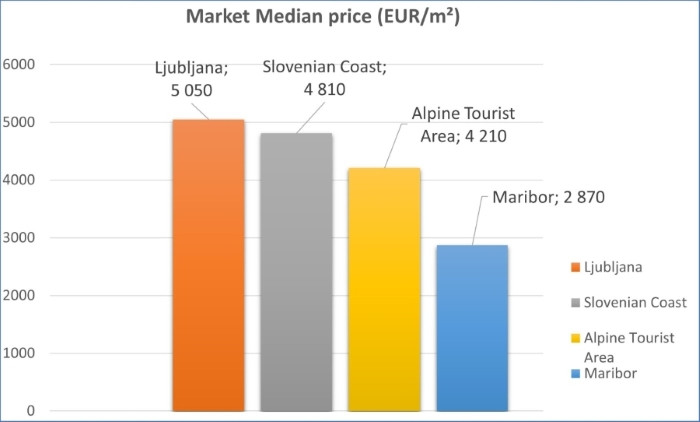
Figure 1. Median prices of existing apartments across Slovenia’s major residential markets (€/m², 2025). Source: GURS.
The recovery in transaction activity reflects improving financing conditions and renewed buyer confidence. Lower interest rates supported mortgage lending, while limited housing supply prevented any meaningful downward pressure on prices.
Unlike markets where higher demand quickly leads to extensive new construction, the Slovenian coast continues to experience a structural imbalance. New residential developments remain relatively limited, allowing existing properties to retain their value even during periods of slower market activity.
For buyers, this means that waiting for a significant market correction may prove unrealistic. Although transaction volumes naturally fluctuate with economic conditions, the long-term pricing trend continues to be supported by constrained supply rather than speculative demand.
Four Coastal Markets, Four Different Profiles
Although official statistics usually present the Slovenian coast as a single market, the reality is more nuanced. Koper, Izola, Piran and Portorož attract different types of buyers, offer different lifestyles and demonstrate different investment characteristics. Understanding these local differences is often more important than analysing regional averages.
Koper is the economic centre of the coast. Strong local employment, the Port of Koper and the largest population in the region create steady demand for primary residences. The market is driven mainly by domestic buyers seeking long-term housing rather than seasonal property.
Izola combines a traditional Mediterranean atmosphere with a limited supply of residential property. Its compact historic centre, marina and waterfront make it attractive to both local buyers and international purchasers looking for second homes. Demand remains relatively stable throughout the year.
Piran is defined by its historic character. Strict heritage protection limits new development, making existing properties particularly scarce. Buyers are often motivated by the uniqueness of the location rather than by expectations of high rental yields.
Portorož represents the premium segment of the Slovenian coast. Luxury apartments, hotels, marinas and wellness facilities attract affluent domestic and international buyers. Property values here are influenced not only by housing demand but also by the area’s reputation as Slovenia’s leading seaside resort.
For investors, treating these municipalities as one uniform market can lead to misleading conclusions. Each responds differently to changes in tourism, local employment, infrastructure and buyer preferences.
Properties for Sale on the Slovenian Coast
Comparing the Slovenian Coast with Other Adriatic Markets
The Slovenian coast is often compared with neighbouring Adriatic destinations such as Croatia, Italy and Montenegro. While these markets share the same sea, they differ significantly in scale, supply and investment dynamics.
Croatia offers thousands of kilometres of coastline and a much broader range of residential developments. Buyers can choose between established tourist destinations and emerging locations with significant room for new construction. This larger supply creates greater price diversity but also stronger competition between projects.
Italy’s Adriatic coast is characterised by mature local markets with wide variations in pricing and demand. In many areas, property values are influenced more by regional economic conditions than by physical constraints on supply.
Montenegro has experienced rapid development over the past two decades, driven largely by foreign investment and large-scale coastal projects. While this has expanded the premium segment, it has also increased the availability of new properties.
The Slovenian coast follows a different model. Its limited size means that supply cannot expand at the same pace as in neighbouring countries. Rather than competing through the volume of new developments, the market is supported by long-term scarcity, stable regulation and consistent domestic demand.
For investors seeking predictable market fundamentals rather than rapid speculative growth, this structural difference is one of the coast’s strongest characteristics.
Who Is Buying Property on the Slovenian Coast?
Demand on the Slovenian coast comes from several distinct groups of buyers, each with different priorities and investment horizons. This diversity contributes to the market’s resilience, reducing its dependence on any single source of demand.
Domestic buyers remain the largest group. Many purchase homes for permanent residence, particularly in Koper and its surrounding municipalities, where employment opportunities and transport connections support year-round demand.
A second group consists of Slovenian and international buyers seeking second homes by the sea. These purchasers are typically less sensitive to short-term market fluctuations and place greater value on location, quality of life and long-term asset preservation.
The coast also attracts investors focused on the holiday rental market. Although tourism creates opportunities for seasonal income, successful investments increasingly depend on location, property quality and compliance with local regulations rather than on tourism growth alone.
International buyers continue to play an important role, particularly within the European Union. For many, Slovenia offers a combination of political stability, legal certainty and a relatively small but transparent property market. Compared with larger Mediterranean destinations, the Slovenian coast appeals to buyers seeking quality over scale.
The presence of multiple buyer groups helps explain why demand has remained relatively stable despite changing economic conditions. When activity slows in one segment, demand from others often continues to support the market.
How Foreigners Can Buy Property in Slovenia: Conditions, Taxes and What Really Matters
Investment Perspective
For long-term investors, the Slovenian coast represents a market driven by scarcity rather than rapid expansion. Unlike destinations where continuous development increases supply, opportunities for new residential projects on the coast remain limited by geography and planning regulations.
This creates a market in which capital preservation is often as important as capital growth. Property values may not experience the dramatic short-term fluctuations seen in more speculative markets, but they are supported by structural factors that are unlikely to change.
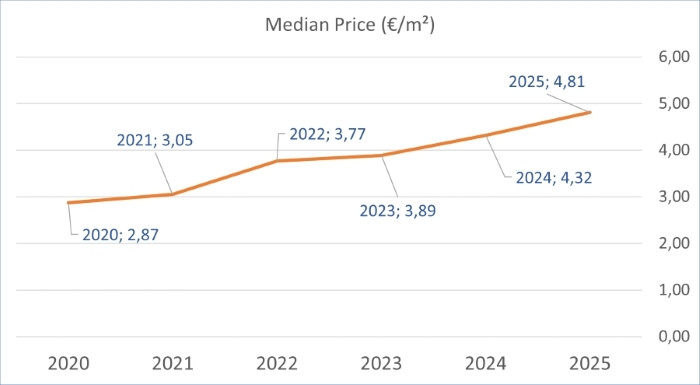
Figure 2. Median prices of existing apartments in Slovenia’s Coastal Area, 2020–2025 (€/m²). Source: GURS.
Investors should also recognise that returns vary between locations. Properties in Koper are typically supported by stable year-round demand, while homes in Portorož or Piran may derive a larger share of their value from lifestyle appeal and premium positioning. Izola often represents a balance between these two characteristics.
Rental income should be viewed as only one component of the investment. Long-term value depends equally on location, building quality, maintenance standards and the scarcity of comparable properties entering the market.
For buyers seeking diversification within the European property market, the Slovenian coast offers an alternative to larger Mediterranean destinations where new supply can have a greater influence on future pricing.
Slovenia Real Estate Market 2025: Prices, Trends and Structural Shift
Risks to Consider
Like any real estate market, the Slovenian coast is not without risks. However, these risks differ from those typically associated with oversupplied or highly speculative markets.
One of the main challenges is affordability. As prices continue to rise faster than household incomes, some local buyers may postpone purchasing decisions, reducing transaction volumes during periods of weaker economic growth.
Another factor is financing. Although lower interest rates have recently supported demand, future changes in monetary policy could affect borrowing costs and temporarily slow market activity.
Investors should also consider regulatory developments. Changes affecting short-term rentals, taxation or urban planning can influence the financial performance of certain properties, particularly those acquired primarily for tourism-related income.
Finally, liquidity varies across market segments. Well-located apartments in established coastal municipalities generally attract consistent buyer interest, while highly specialised or premium properties may require longer selling periods due to a smaller pool of potential purchasers.
None of these risks fundamentally changes the structural characteristics of the market. Instead, they highlight the importance of careful property selection, realistic investment expectations and a long-term perspective.
How Foreigners Can Buy Property in Slovenia: Conditions, Taxes and What Really Matters
Outlook
The long-term outlook for the Slovenian coastal property market remains positive. While annual price growth is unlikely to remain in double digits indefinitely, the fundamental drivers of the market show little sign of changing.
Geographical limitations cannot be expanded, planning regulations are expected to remain strict, and demand for high-quality coastal property continues to benefit from Slovenia’s economic stability and attractive quality of life.
Future market performance will depend more on interest rates, household purchasing power and the pace of new residential development than on speculative investment activity. However, given the limited capacity for significant supply growth, the structural imbalance between supply and demand is likely to persist.
For buyers and investors with a long-term horizon, the Slovenian coast is expected to remain one of the country’s most resilient residential markets.
Conclusion
The Slovenian coast is one of the most distinctive residential property markets in the Adriatic region. Its long-term performance is shaped less by short-term economic cycles than by structural factors that cannot easily be changed. Limited land availability, strict planning regulations and consistent demand continue to support property values across the region.
Although each coastal municipality has its own market characteristics, they share one important feature: supply remains constrained while demand persists. This combination has helped the coastal market remain resilient through changing economic conditions and has reinforced its position as one of Slovenia’s most stable residential markets.
For buyers, the Slovenian coast offers more than a seaside lifestyle. For investors, it represents a market where long-term fundamentals are often stronger than short-term market sentiment. Understanding these structural drivers is essential for making informed property decisions.
Properties for Sale on the Slovenian Coast
ALTUM CAPITAL Insight
Official statistics describe the Slovenian coast as a single market. In practice, buyers choose between four distinct markets with different demand drivers, pricing dynamics and investment profiles. Understanding these local differences is often more valuable than relying on regional averages.
Why Work with ALTUM CAPITAL
Choosing property on the Slovenian coast requires more than comparing prices. Each municipality has its own planning rules, buyer profile and investment dynamics, making local expertise essential.
ALTUM CAPITAL works across the entire Slovenian coastal region, helping international buyers identify properties that match their investment goals, lifestyle preferences and long-term plans. Our approach combines official market data, practical transaction experience and independent analysis to support informed purchasing decisions.
Whether you are looking for a permanent residence, a holiday home or an investment property, we provide guidance throughout every stage of the acquisition process.
Explore our latest properties on the Slovenian coast or contact ALTUM CAPITAL for personalised advice.
Frequently Asked Questions About the Slovenian Coast Real Estate Market
Is the Slovenian coast a good place to invest in real estate?
The Slovenian coast combines limited housing supply, stable domestic demand and a transparent legal environment. These structural characteristics have helped it remain one of the country’s most resilient residential property markets over the long term.
Can foreigners buy property on the Slovenian coast?
Yes. Citizens of EU countries can generally purchase property under the same conditions as Slovenian citizens. Buyers from non-EU countries are subject to Slovenian legislation and applicable international agreements.
Which coastal town is best for investment: Koper, Izola, Piran or Portorož?
Each municipality serves a different market. Koper is driven by year-round residential demand, Izola offers a balance between lifestyle and investment, Piran attracts buyers seeking historic character, while Portorož represents the premium coastal segment.
Is there enough new construction on the Slovenian coast?
No. New residential projects are relatively limited due to geographical constraints, environmental protection and planning regulations. As a result, supply grows much more slowly than in many other Adriatic markets.
Will property prices continue to grow?
No market can guarantee future price growth. However, the long-term outlook remains supported by limited supply, stable demand and the structural characteristics of the Slovenian coastal market.
Is the Slovenian coast better for capital appreciation or rental income?
The market has traditionally been stronger in preserving and gradually increasing property values than in delivering exceptionally high rental yields. The investment outcome depends on the property’s location, quality and intended use.
What should buyers consider before purchasing property on the Slovenian coast?
Location, planning restrictions, building condition, future maintenance costs and long-term market fundamentals are all important factors. Buyers should evaluate each property individually rather than relying solely on regional price averages.
Part of the ALTUM CAPITAL Research Series
This report is part of ALTUM CAPITAL’s ongoing series of independent analyses covering Slovenia’s residential real estate market.


