
Slovenian Real Estate Investment: How Tourism Growth Is Reshaping Regional Markets
Prefer listening to reading?
Tourism Is Growing, but Regional Trends Vary
According to the Statistical Office of the Republic of Slovenia (SURS), Slovenia recorded 16.07 million tourist overnight stays between January and September 2026. This represents a 7.1% increase compared with the same period in the previous year.
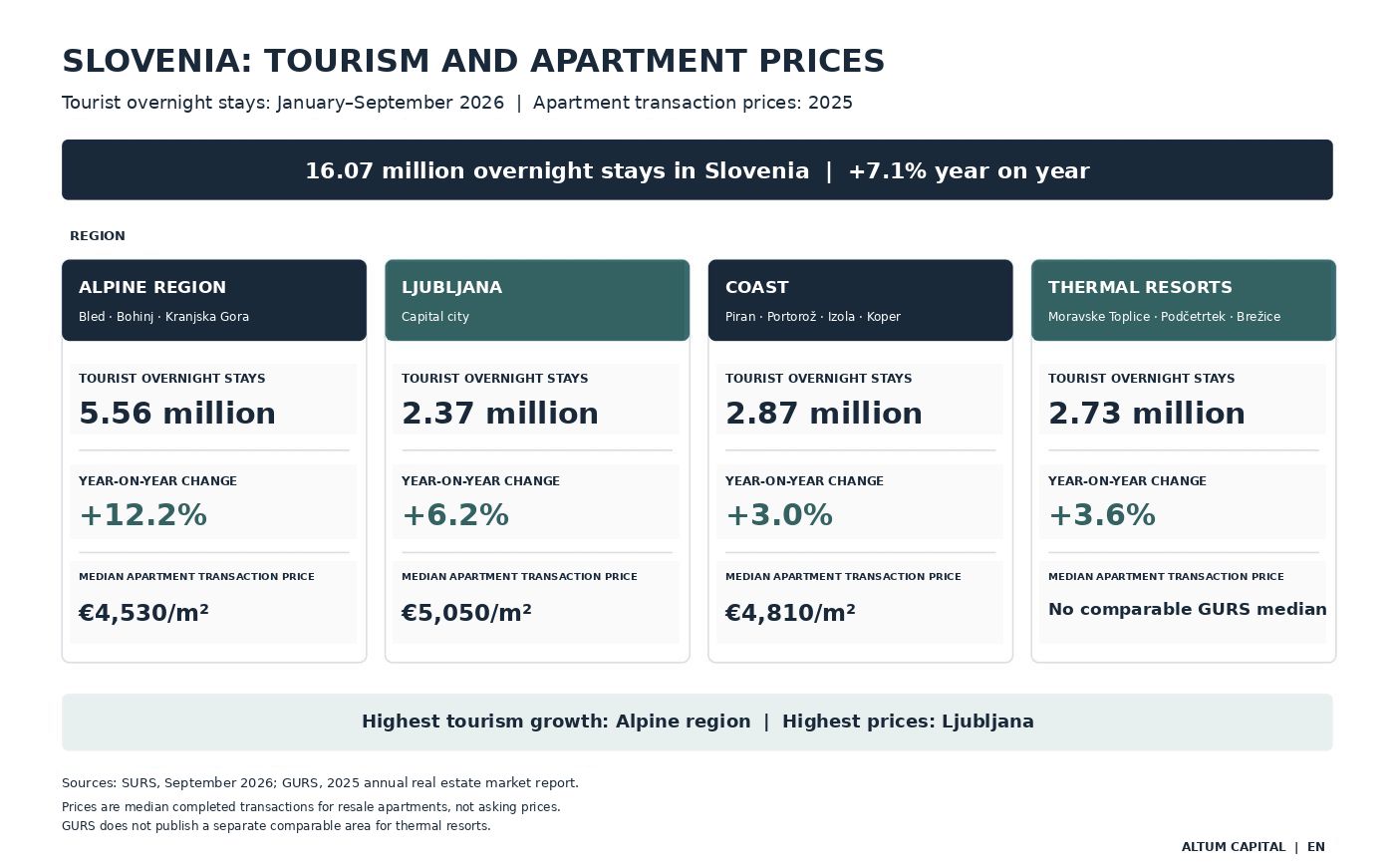
Mountain resorts recorded the strongest growth at 12.2%. Overnight stays increased by 6.2% in Ljubljana, 3.6% at thermal resorts and 3% on the coast.
The performance of Alpine Slovenia is particularly noteworthy. The region recorded 5.56 million overnight stays in the first nine months of the year, making it one of the country’s most dynamic tourism markets.
Four Regions with Different Investment Potential
1. Alpine Slovenia: The Fastest Growth in Tourist Demand
Bled, Bohinj and Kranjska Gora attract international visitors throughout the year. The region combines natural attractions, winter sports, outdoor recreation and well-developed tourism infrastructure.
In the first nine months of 2026, mountain resorts recorded 5.56 million overnight stays, an increase of 12.2%.
The median transaction price for apartments in the Alpine tourist area was €4,530/m² in 2025.
A limited supply of attractive properties and growing international interest support the region’s investment appeal. However, investors must also consider seasonality, operating costs and restrictions on short-term rentals.
2. Adriatic Coast: Limited Supply and High Property Prices
Piran, Portorož, Izola and Koper are among Slovenia’s most expensive residential markets.
In 2025, the median transaction price for apartments on the coast reached €4,810/m². Between January and September 2026, the region recorded 2.87 million tourist overnight stays, an increase of 3%.
The region is characterised by limited opportunities for new construction, international demand and the appeal of the Mediterranean lifestyle.
High acquisition costs make it particularly important to select the right property and assess its investment model carefully.
3. Ljubljana: A Market with Year-Round Demand
The capital remains the country’s largest business, education and administrative centre. It is home to international companies, universities and a significant share of Slovenia’s labour market.
In the first nine months of 2026, Ljubljana recorded 2.37 million tourist overnight stays, an increase of 6.2%.
The median transaction price for apartments reached €5,050/m² in 2025, the highest figure among the markets considered here.
For investors, Ljubljana is particularly attractive for long-term rentals, residential property and commercial real estate. Unlike resort destinations, demand is not limited to the tourist season.
4. Thermal Resorts: An Alternative Segment
Slovenia has a well-developed thermal and wellness tourism infrastructure. Among the best-known complexes are:
- Terme 3000 in Moravske Toplice.
- Terme Olimia in Podčetrtek.
- Terme Čatež in Čatež ob Savi, in the municipality of Brežice.
These destinations cater to health, wellness and family tourism.
In the first nine months of 2026, thermal resorts recorded 2.73 million overnight stays, an increase of 3.6%.
Investment opportunities may include apartments, hospitality properties and hotel projects associated with tourism infrastructure.
However, this is a diverse market. Demand for a particular property depends largely on its location, local infrastructure and proximity to established thermal complexes. GURS does not provide a comparable median apartment price for this group of resorts.
Property Prices and Tourist Demand: Different Indicators
According to GURS, median apartment transaction prices in 2025 were:
| Market | Median transaction price |
|---|---|
| Ljubljana | €5,050/m² |
| Adriatic Coast | €4,810/m² |
| Alpine tourist area | €4,530/m² |
| Slovenia overall | €3,200/m² |
These figures reflect actual transactions rather than asking prices.
Tourism growth can support demand for real estate, but it does not in itself guarantee high returns. Acquisition costs, operating expenses, seasonality, competition and the ability to rent out a property legally all play an important role.
For a more detailed analysis of price and transaction trends, see our article Slovenian Real Estate Market: Q2 2026 Review.
Short-Term Rentals: What Investors Need to Know
From 1 January 2027, restrictions under Slovenia’s new Hospitality Act (ZGos-1) begin to apply.
The national list of municipalities at high risk of negative impacts from short-term rentals includes 14 municipalities: Ankaran, Bled, Bohinj, Bovec, Cerklje na Gorenjskem, Gorje, Izola, Koper, Kranjska Gora, Ljubljana, Piran, Preddvor, Radovljica and Žirovnica.
Under the general rule, the short-term letting of individual apartments in these municipalities is limited to 60 days per calendar year. However, the law allows municipalities to set their own limits within a range of 30 to 270 days.
For example, the municipality of Bled allows up to 270 rental days per year for apartments in most of its territory and up to 180 days for certain categories of accommodation providers. In designated multi-apartment zones, the limit is 30 days.
In Kranjska Gora, three territorial categories apply: up to 60 days in multi-apartment buildings, up to 270 days in designated tourism accommodation zones and up to 180 days in the remaining areas.
The permitted duration of short-term rentals therefore depends not only on the municipality but, in some cases, also on the specific location and type of building.
These restrictions apply to short-term rentals of residential premises. They cannot automatically be extended to hotels and other distinct categories of registered accommodation establishments.
For investors, this means that the legal status of a property, the applicable municipal ordinance and the permitted use of the premises must be checked before purchase.
How to Choose an Investment Property in Slovenia
When assessing a property, investors should consider not only its location and price but also several practical factors:
- Actual demand for housing or tourist accommodation.
- Completed transaction prices in the specific location.
- The conditions and restrictions governing property rentals.
- Taxes, operating expenses and property management costs.
- The property’s liquidity and resale prospects.
There is no universally best region for real estate investment. Ljubljana, the coast and the Alps offer different ownership models and risk profiles.
Slovenia: Investment Opportunities Beyond the Traditional Markets
Tourism growth is increasing interest in real estate across different parts of Slovenia. Alpine resorts are recording the strongest growth in tourist demand, the coast remains a high-priced market with limited supply, and Ljubljana remains the country’s largest year-round market.
For investors, the priority is not simply to choose a popular destination but to identify a property whose acquisition cost, actual demand and legal conditions of use align with their investment strategy.
For 10 years, ALTUM CAPITAL has been helping investors from around the world navigate the Slovenian real estate market, select properties and manage transactions in line with their individual goals and interests.
About This Analysis
This review is part of a series of independent studies by ALTUM CAPITAL examining Slovenia’s residential real estate market.
We regularly publish analytical articles based on official statistics, practical experience in real estate transactions and long-term observation of market developments, helping buyers and investors make more informed decisions.


